Why Verification Matters More Than the Mark
Shariah review: Mufti Abdul Sattar Madani · Editorial standards
There is a quiet problem at the heart of Halal certification, and it is not about ingredients or slaughter or supply chains. It is about the mark itself. A Halal logo on a package is a symbol, and symbols can be copied. A mark tells you that someone, at some point, claimed a product was certified. It does not, on its own, tell you whether that claim is current, in scope, or even real. Verification is what closes that gap — and it matters more than the mark it confirms.
The trouble with a mark alone
Consider what a logo actually proves. It proves that a logo is present. It does not prove that the certificate behind it is still valid, that the product in front of you is within the certified scope, or that the certificate was issued by the body the logo claims. Marks can be applied to products that were never certified, kept on packaging after a certificate has lapsed, or copied outright. The symbol is trivially forgeable; the record behind it is not.
- A mark can outlive the certificate it represents, staying on packaging after the certificate has expired
- A mark can be applied to products outside the actual certified scope
- A mark can be counterfeited, lifted from a legitimate product onto an illegitimate one
- A mark gives no way to confirm the issuing body or the current status
What verification adds
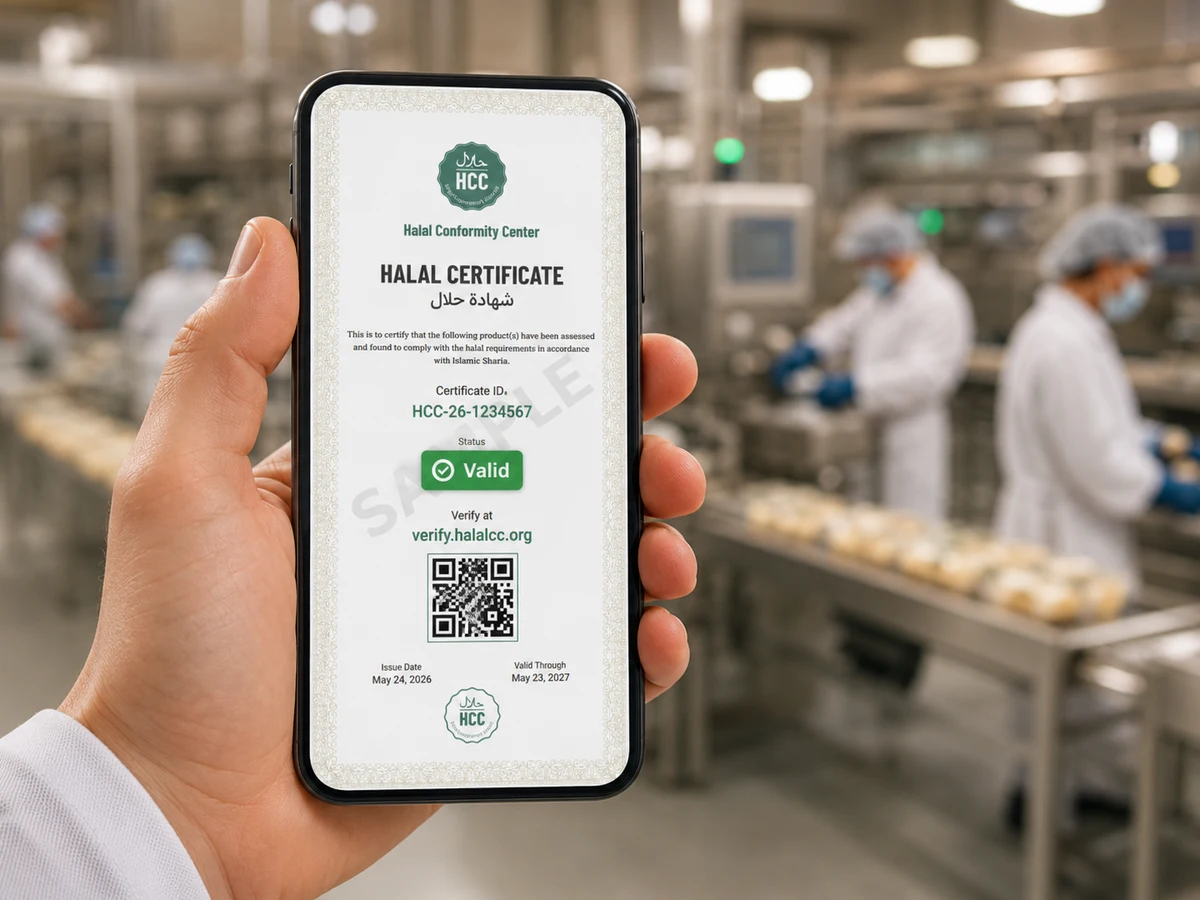
Verification replaces "trust the symbol" with "check the record." Instead of relying on a logo, anyone — a buyer, a retailer, a customs office, a curious consumer — confirms the certificate against the issuing body's live record. The status, the scope, and the validity come straight from the source, not from a printed image that may be stale or false.
At HCC, every certificate carries an identifier that anyone can check at verify.halalcc.org. There is no account to create and nothing to install. You enter the ID and you see the truth: what is in scope, whether it is current, and that the certificate is genuine. The same record is re-audited annually through a surveillance audit, so what you see reflects reality rather than a snapshot from issuance day.
A mark says "trust me." A verifiable record says "check for yourself." Only one of those is trust you can ship.
Verification protects honest manufacturers
It is worth emphasising who benefits most from verification: the manufacturers who do the work properly. When a mark can be faked, an honest manufacturer competes against counterfeit claims that cost nothing to print. Public verification levels that field. A genuine certificate can be confirmed; a fake one cannot. The manufacturer who invested in a real audit gets a record that distinguishes them from anyone simply printing a logo.
This is why verification is not an administrative add-on to certification. It is the mechanism that gives certification its value. Without it, the whole system rests on the unverifiable presence of a symbol.
Verification as infrastructure
The deeper point is that verification turns certification from a document into infrastructure. A document sits in a drawer. Infrastructure is something other people build on — an importer who clears a shipment, a retailer who lists a product, a regulator who confirms a claim, all relying on the same live record. The certificate stops being a private reassurance between manufacturer and certifier and becomes a public utility that the whole supply chain can use.
That is the standard a serious certification body should be held to. Not "do you issue marks?" but "can anyone, anywhere, confirm the claim in seconds, and is that confirmation current?" The mark is the surface. Verification is the substance. And in a market built on trust, the substance is what matters.
What Is Halal Certification, Really?
Halal certification is not a sticker — it is a documented claim a buyer or regulator can check. Here is what it covers, who it is for, and how it is built.

The Halal Certification Process, Step by Step
From the first application to a publicly verifiable certificate and the annual re-audit that keeps it honest — how Halal certification actually works.

Halal Logistics and Chain of Custody
A product can be certified at the line and still lose its integrity in transit. Chain of custody is how a Halal claim survives the journey to the shelf.
Ready to get certified?
Average issuance is about ten days from a clean application. Submit a batch for audit, or talk to a certification advisor about your scheme, market, and timeline.