What Is Halal Certification, Really?
Shariah review: Mufti Abdul Sattar Madani · Editorial standards
Ask ten people what Halal certification means and you will get ten answers. To a shopper it is a mark on a label. To a factory it is an audit on the calendar. To an importer it is a line item that customs may ask about. All of those are true, but none of them is the whole picture. At its core, Halal certification is a verifiable claim: an independent body has examined a product, its ingredients, and the conditions under which it was made, and is willing to attest that the result conforms to Halal requirements.
The word that matters in that sentence is verifiable. A claim that cannot be checked is just a promise. A claim that anyone can confirm — a buyer, a regulator, a customs officer — is infrastructure. That difference is the entire reason certification exists.
What the certificate actually covers
A Halal certificate is scoped. It does not say "this company is Halal" in the abstract; it says "this product, made at this facility, within this scope, conforms." Getting that scope right is most of the work. A serious certification body looks past the finished label and into the supply chain behind it, because that is where the risk lives.
- Ingredients and additives — including processing aids, carriers, and the components that never appear on a front-of-pack label
- The source of every animal-derived or fermentation-derived input, traced back through suppliers
- Cleaning, segregation, and cross-contamination controls on shared production lines
- Traceability from incoming goods all the way to the finished, labelled unit that ships
- Storage and logistics — the chain of custody to the point of dispatch
Notice how much of that has nothing to do with the obvious. People expect a Halal audit to ask about meat and alcohol. They are often surprised that it asks about an emulsifier, a release agent on the packaging film, or the growth medium behind an enzyme. The unglamorous details are exactly where an uncertified product quietly slips out of conformity.
Who it is for
Certification is rarely about the domestic shelf alone. Most manufacturers pursue it because a customer, a retailer, or an export market expects it. A Gulf importer may require it before a shipment clears. A multinational buyer may make it a condition of supply. A growing share of brand owners now ask for it across categories where it was once rare — packaging, cosmetics, even excipients in a supplement.
In every one of those cases, the value is the same: the certificate lets the other party trust the claim without having to re-audit the factory themselves. It turns a private assurance into a public, checkable record.
How a credible certificate is built
There is a recognisable arc to a sound certification process, and it is worth knowing what good looks like before you commit to it. An application defines the scope. An auditor reviews documents and inspects the facility. Where appropriate, laboratory and Shariah review confirm the technical and religious basis. Only then is a certificate issued — with an identifier attached to it.
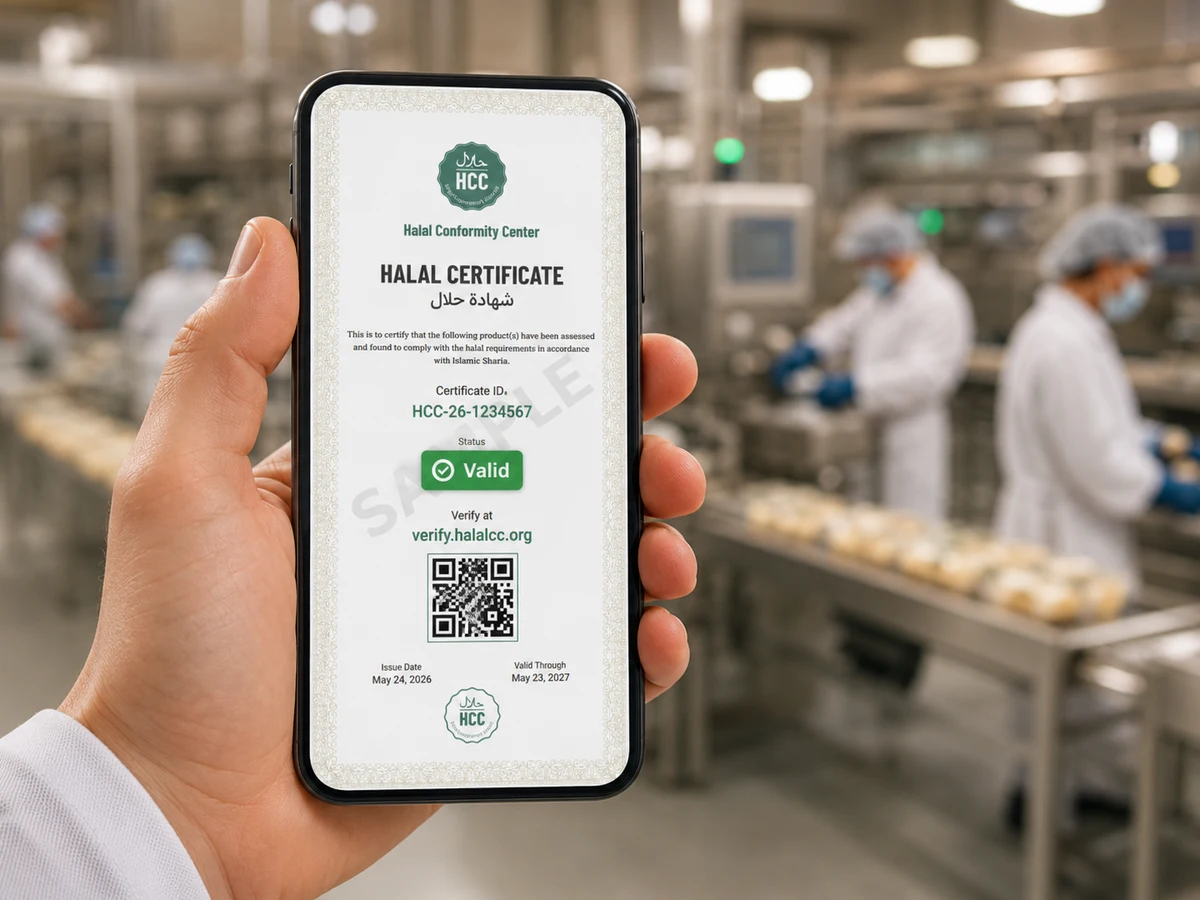
A certificate that nobody can check is decoration. A certificate that anyone can verify, in seconds, is trust you can ship.
That identifier is the part most people overlook and the part that matters most. At HCC, every certificate carries an ID that anyone can confirm at verify.halalcc.org — no account, nothing to install. The same record is re-audited annually through a surveillance audit, so the status reflects reality, not a snapshot from issuance day. Certification is not a one-time event; it is a standing claim that stays true only if someone keeps checking.
A note on recognition
No single certificate is automatically accepted everywhere. Acceptance flows through recognition: relationships between certification bodies, national authorities, and coordination organisations. HCC's reach into more than 180 markets is reach through its partner network — products certified by HCC are recognised in the destination markets reached via those partners. That distinction is not a technicality. It is the honest description of how global Halal trade actually works, and it is the difference between a mark that travels and one that stops at the border.
So when someone asks what Halal certification really is, the short answer is this: it is a scoped, audited, verifiable claim — built carefully, kept current, and recognised through a network. Everything else is detail. Important detail, but detail.

The Halal Certification Process, Step by Step
From the first application to a publicly verifiable certificate and the annual re-audit that keeps it honest — how Halal certification actually works.
Why Verification Matters More Than the Mark
A Halal logo is only as good as the record behind it. Real-time verification is what turns a claim into trust — and protects honest makers from fake marks.
Ready to get certified?
Average issuance is about ten days from a clean application. Submit a batch for audit, or talk to a certification advisor about your scheme, market, and timeline.