The Halal Certification Process, Step by Step
Shariah review: Mufti Abdul Sattar Madani · Editorial standards

The certification process can feel opaque from the outside, which is unfortunate, because the steps are straightforward and there are no surprises if you know what to expect. This is a map of the journey — from the moment you decide to certify to the day a buyer confirms your certificate at the border.
Step 1 — Scope the application
Everything starts with scope. Before anyone schedules an audit, the question is simple: what, exactly, are you certifying? A single ingredient? A processing aid? A finished retail SKU? An entire facility? The answer shapes the whole engagement, because the certificate will state precisely what was examined and nothing more.
At this stage you tell us your products, your facility, and the markets you ship to. A good certification body uses that to define the audit so it is neither too narrow to be useful nor so broad that it becomes slow and expensive. Get the scope right and the rest of the process follows cleanly.
Step 2 — Document review
Much of the work happens on paper before anyone walks the floor. The auditor reviews ingredient declarations, supplier specifications, batch records, cleaning and segregation procedures, and traceability documentation. The aim is to build a complete picture of what goes into the product and how it is controlled.
- Full ingredient and additive list, including processing aids and carriers
- Supplier Halal status for every animal-derived or fermentation-derived input
- Cleaning validation and segregation procedures on shared lines
- Traceability records from incoming goods to finished unit
This is the stage where applications most often stall — not because something is wrong, but because a single supplier specification is missing or a carrier is undeclared. Preparing this documentation thoroughly before the audit is the most reliable way to keep issuance fast.
Step 3 — Facility inspection
Documents describe how things should work; the inspection confirms how they actually work. An HCC auditor visits the facility to verify that practice matches the paperwork — that segregation is real, that cleaning is performed and validated, that the products on the line are the products in the file. Where the scheme calls for it, laboratory analysis and Shariah review confirm the technical and religious basis of the decision.
Step 4 — Decision and issuance
With the review and inspection complete, the certification body makes a decision. If everything conforms, a certificate is issued, scoped exactly to what was audited. If something cannot be established, the body says so and explains what would need to change. A credible body does not negotiate the standard; it tells you the truth and, where helpful, suggests a path — a documented Halal supplier, a plant-based substitute, a corrected procedure.
Issuance is not the finish line. It is the start of a claim that has to stay true.
Step 5 — Public verification
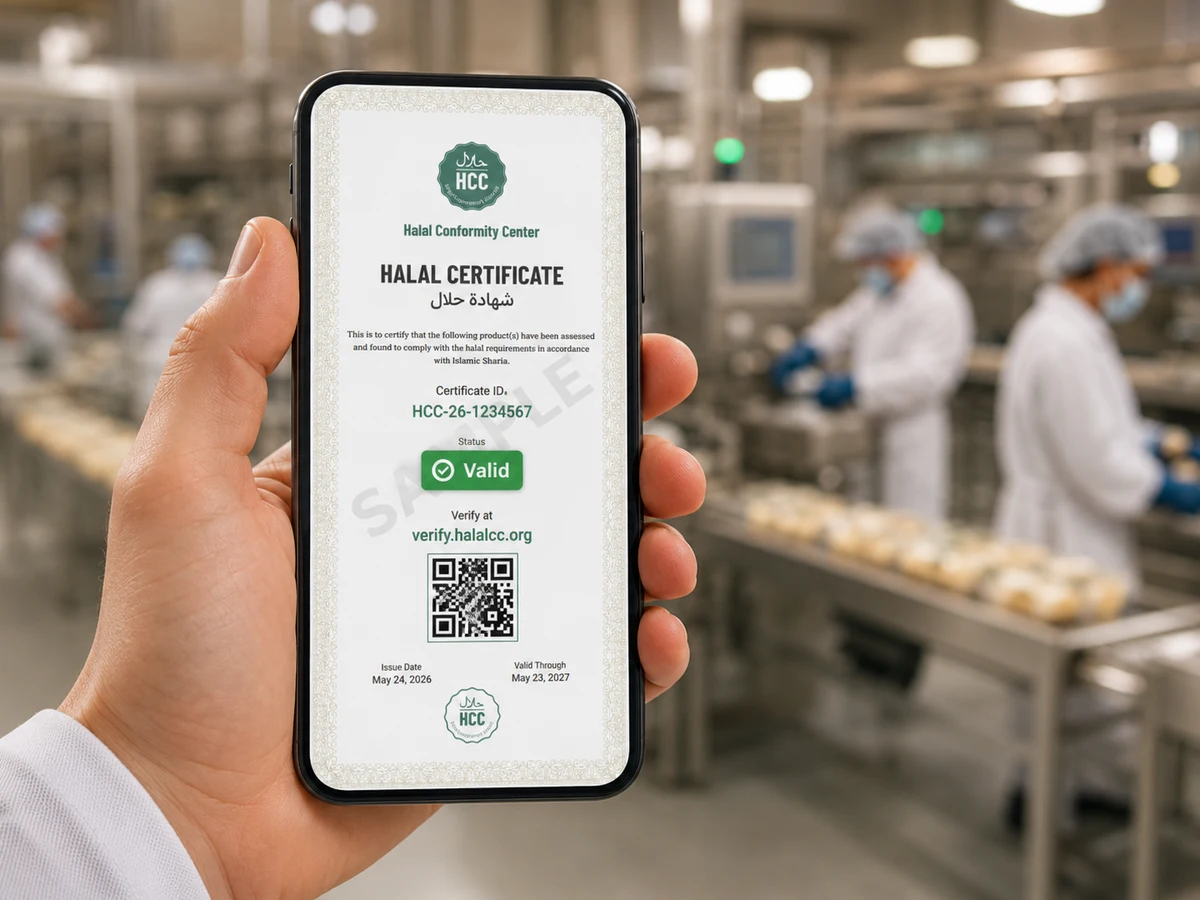
Every HCC certificate carries an identifier that anyone can check at verify.halalcc.org. An importer, a retailer, or a customs office confirms the scope, status, and validity in seconds — no account, nothing to install. This is what makes the certificate useful beyond your own walls: the other party never has to take your word for it.
Step 6 — Annual surveillance re-audit
Supply chains drift. A supplier changes a source, a formulation is tweaked, a new line is added. A certificate that was accurate at issuance can quietly become stale. To prevent that, HCC re-audits annually through a surveillance audit, so the public record reflects current reality rather than a single moment in the past. Certification, done properly, is a standing relationship, not a one-time stamp.
How long does it take?
From a clean, complete application, average issuance is about ten days. The variable is almost always documentation: the faster the supplier specifications and ingredient declarations come together, the faster the certificate is issued. That is why scoping and document preparation — the first two steps — repay the effort many times over.
None of this should feel mysterious. A good process is legible: you know what is being checked, why, and how the result can be confirmed. If a certification body cannot explain its own steps plainly, that is information too.

What Is Halal Certification, Really?
Halal certification is not a sticker — it is a documented claim a buyer or regulator can check. Here is what it covers, who it is for, and how it is built.
Why Verification Matters More Than the Mark
A Halal logo is only as good as the record behind it. Real-time verification is what turns a claim into trust — and protects honest makers from fake marks.

Exporting to the GCC: Understanding Halal Requirements
The Gulf is one of the most demanding Halal export destinations. Acceptance runs through recognition and standards alignment — and must work at the border.
Ready to get certified?
Average issuance is about ten days from a clean application. Submit a batch for audit, or talk to a certification advisor about your scheme, market, and timeline.