
Halal Logistics and Chain of Custody
Shariah review: Mufti Abdul Sattar Madani · Editorial standards

It is tempting to think the Halal question is settled the moment a product leaves the production line correctly made. It is not. A certified product can lose its integrity in the warehouse, in the container, or on the truck — through contamination, mislabelling, or co-storage with non-Halal goods. Chain of custody is the discipline that keeps a Halal claim intact from the factory floor to the point of sale, and it is one of the most underappreciated parts of certification.
What chain of custody means
Chain of custody is the documented, unbroken trail that shows a product remained Halal-conformant through every hand-off after production. It is not about how the product was made; it is about everything that happens afterward — storage, handling, transport, and the records that prove segregation and integrity at each step.
For some products this is trivial; for others it is the whole ballgame. A shelf-stable, sealed retail SKU carries low risk. Bulk ingredients, cold-chain goods, and products that share storage or transport with non-Halal items carry real risk that only documented controls can manage.
Where integrity is lost
- Co-storage — Halal and non-Halal goods sharing a warehouse without segregation or clear labelling
- Shared transport — mixed loads where contamination or cross-contact is possible
- Bulk handling — tankers, totes, and silos that previously held non-conformant product without validated cleaning
- Re-labelling and repackaging — points where a product can be mislabelled or its identity confused
- Third-party logistics — handoffs to operators outside the manufacturer's direct control
Each of these is a place where an otherwise perfect product can quietly fall out of conformity. The integrity built at the line is only as durable as the weakest link in the chain that follows.
Certification at the line is a promise. Chain of custody is what keeps the promise on the way to the shelf.
Certifying the logistics layer
This is why logistics and cold-storage operators increasingly seek certification in their own right. A third-party logistics provider that holds a verifiable Halal certificate gives manufacturers and importers confidence that segregation, handling, and traceability are controlled all the way through. The audit of a logistics operation examines exactly the failure points above:
- Segregation of Halal and non-Halal goods in storage and transport
- Validated cleaning for shared bulk handling equipment
- Labelling, lotting, and traceability through every hand-off
- Documented procedures and staff training across the operation
- Chain-of-custody records from intake to dispatch
Why it matters for export
Chain of custody becomes especially important in export, where a product may change hands several times and cross multiple borders before it reaches a shelf. A buyer or customs office at the destination is trusting not just that the product was made correctly, but that it stayed conformant the entire way. A documented chain of custody, anchored to a verifiable certificate, is what makes that trust possible at a distance.
The practical lesson for manufacturers is to think past the loading dock. Map who handles your product after it leaves your facility, where it is stored, and how it is transported. Where those handoffs involve shared facilities or third parties, documented segregation — and, ideally, certification of the logistics layer — is what carries your Halal claim safely to the end of the journey.
It is the unglamorous half of certification, and the half that quietly determines whether the claim you worked to earn is still true by the time someone relies on it.

Exporting to the GCC: Understanding Halal Requirements
The Gulf is one of the most demanding Halal export destinations. Acceptance runs through recognition and standards alignment — and must work at the border.
Why Verification Matters More Than the Mark
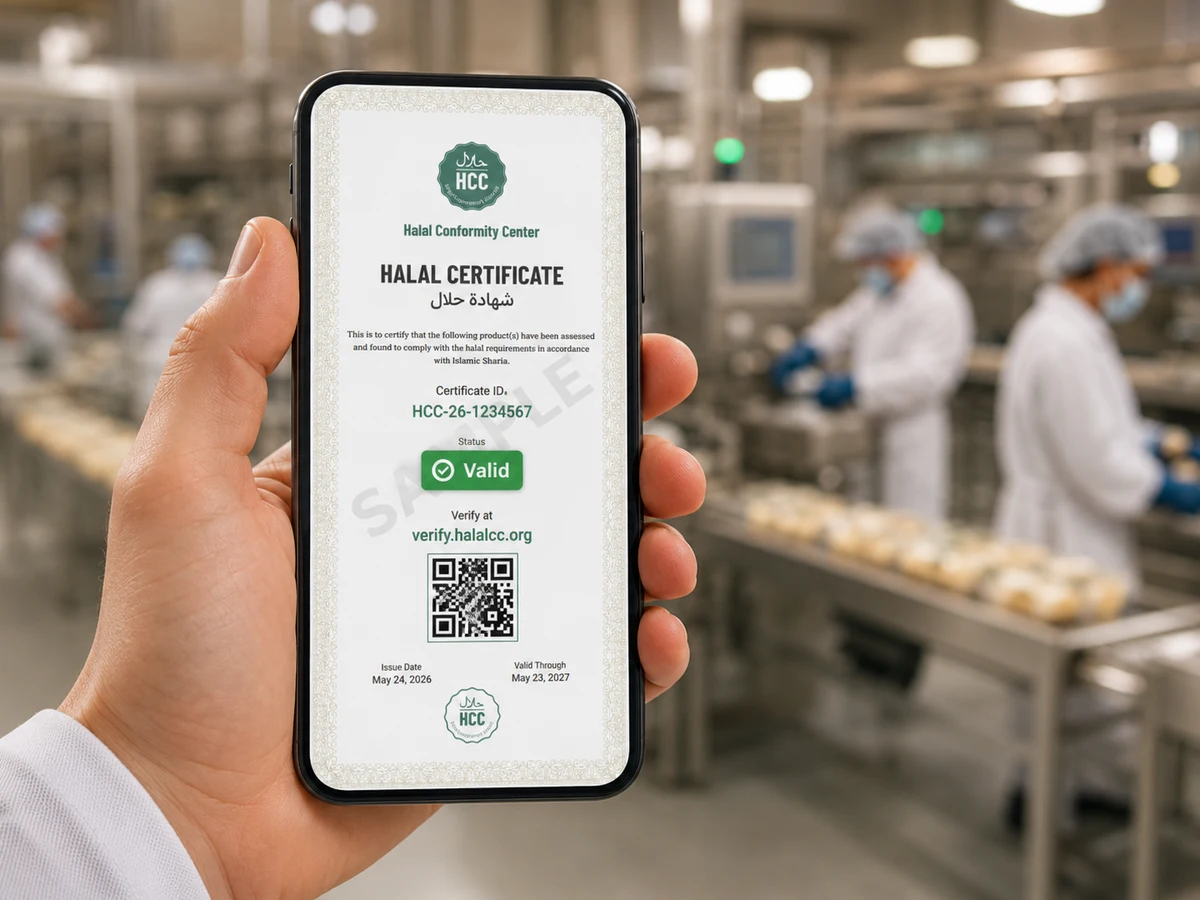
A Halal logo is only as good as the record behind it. Real-time verification is what turns a claim into trust — and protects honest makers from fake marks.

The Halal Certification Process, Step by Step
From the first application to a publicly verifiable certificate and the annual re-audit that keeps it honest — how Halal certification actually works.
Ready to get certified?
Average issuance is about ten days from a clean application. Submit a batch for audit, or talk to a certification advisor about your scheme, market, and timeline.