Global Halal Market Size: The 2028 Opportunity
Shariah review: Mufti Abdul Sattar Madani · Editorial standards
The global halal market size is not a statistic to file away. It is a forecast a manufacturer can plan a decade around, and it is moving in one direction. Consumer spending across the halal economy reached US$2.43 trillion in 2023 and is on track for US$3.36 trillion by 2028, a compound annual growth rate of 5.5% (DinarStandard, State of the Global Islamic Economy 2024/25). Behind that number sit close to two billion Muslim consumers. The question for a US manufacturer is no longer whether the market is large enough to matter. It is whether your product can get in.
There is a deadline attached to that question, and it is closer than most people think. Indonesia’s mandatory halal law now requires imported food and beverage products to be halal-certified by 17 October 2026. That is not a marketing target; it is a border. A manufacturer without a recognised certificate on that date does not lose a marketing opportunity in the world’s largest Muslim-majority market. It loses the shelf.
What the $2.43 trillion figure actually means
A trillion-dollar figure is easy to quote and hard to feel. Break it into the segments a manufacturer actually sells into and it becomes concrete. Halal food is the largest by far, growing from $1.43 trillion in 2023 toward $1.94 trillion in 2028. Cosmetics climb from $87 billion to $118 billion, and pharmaceuticals get a section of their own further down this post. Modest fashion, travel, and Islamic finance add their own trillions on top.
These are not niche categories. They are the same categories a US food, supplement, or personal-care company already competes in domestically. The difference is that a large and growing share of the demand now sits behind a certification requirement the domestic market never imposed. The market is not asking you to build a new product. It is asking you to prove the one you already make conforms.
Where the growth is fastest
The headline CAGR of 5.5% understates the opportunity in the markets moving quickest. Imports into the Organisation of Islamic Cooperation countries — the halal-related goods those markets buy from the rest of the world — are projected to grow from $407.8 billion in 2023 to $608.4 billion in 2028, a rate of 8.3% a year. That is the number that matters to an exporter, because it measures demand that has to be met from outside.
Africa is the fastest-growing halal market of all, expanding at 9.6% a year. For a manufacturer thinking three to five years ahead, the map is worth reading carefully: the largest markets are not always the fastest, and a certificate recognised across a partner network reaches destinations a single national approval never would. HCC’s global partner network is approved by JAKIM, BPJPH, MUIS, EIAC, SMIIC, and other major accreditation bodies, giving HCC-certified products access to more than 180 markets through that network.
Four segments deserve their own read, because each turns the headline number into a specific buyer with a specific requirement.
The Halal packaging market rides the food curve
Packaging looks like an afterthought until an audit reads the specification. Films, coatings, printing inks, release agents, and stearates can each carry a status question, and a package that cannot document them leaves the audit with a question to resolve before the claim clears. That is why food-contact packaging is certified as part of the product's chain — and why packaging demand tracks the largest segment directly. As Halal food grows toward the 2028 figure quantified at the top of this post, the packaging around it falls under the same documentation demand, and converters and film suppliers are increasingly asked for paperwork their customers' audits require.
The Halal ingredients market moves before the shelf does
Every certified finished product pulls certification upstream. Emulsifiers, enzymes, gelatin, flavors, colors — these are where status questions actually live, so a manufacturer's audit lands on its ingredient suppliers' paperwork, and the supplier who can document Halal status wins the specification. Regulation is compounding the pull: Indonesia's mandatory Halal law applies to raw materials and additives, not only finished goods. For an ingredient maker, a certificate is less a label than a sales document — it is what lets a customer's application clear without a substitution. Our E-numbers reference shows how often one additive code hides the whole question.
The Halal logistics market is where custody becomes commercial
A certificate protects a product to the point it leaves the facility; logistics decides whether the claim survives the journey. Segregated warehousing, cleaned or dedicated containers, and custody records that hold at every hand-off are what let a certificate still mean something at the destination port. The scale follows the trade flow: the OIC import demand quantified in the growth section above all has to be moved and stored without breaking status. For carriers and third-party logistics providers, that is a service line — and the chain of custody behind it is a discipline of its own.
The Halal pharmaceuticals market grows faster than food
Pharma is the segment where technical depth pays. Halal pharmaceutical spending is projected to rise from $107 billion in 2023 to $149 billion by 2028, a faster growth rate than food's (DinarStandard, SGIE 2024/25). The status questions rarely concern the active ingredient. Capsule gelatin, glycerin, stearates, and the excipients around the API are where conformity is decided, which is why a review of excipients runs alongside a facility's existing GMP records rather than replacing them. This is chemistry work, and HCC staffs it accordingly — biochemists and microbiologists audit beside Islamic scholars.
The US opportunity is demand-led, not mandate-led
Here is the part that trips up American manufacturers. In the United States there is no government halal mandate and no federal halal stamp. The FDA does not regulate religious dietary claims at all. The USDA oversees halal labelling on meat and poultry, but there is no “USDA-Halal” seal the way there is a USDA Organic seal. A halal claim in the US is only ever as credible as the third-party certifier standing behind it.
That absence of a mandate is easy to misread as an absence of demand. It is the opposite. US halal demand is pulled by buyers, not pushed by regulators — retailers stocking a growing Muslim consumer base, distributors serving export accounts, multinational buyers who make certification a condition of supply. The demand is real; it simply arrives as a purchase order rather than a law. And a demand-led market rewards the manufacturers who move before they are forced to, because they are the ones already on the shelf when the buyer’s checklist adds a line.
Why the global halal market size belongs in your growth strategy
Treat the global halal market size as a growth input, not a trivia item, and it changes the arithmetic. A US manufacturer weighing certification is really weighing access to a $3.36 trillion consumer economy growing faster than the domestic market it already serves. The certificate is the entry cost. The market behind it is the return.
The certificate is the entry cost. A $3.36 trillion market growing faster than your home turf is the return.
The cost of waiting is quieter but just as real. If a competitor on the next shelf is certified and you are not, the importer’s checklist now has a missing tick against your name — and checklists do not negotiate. Every month a product stays uncertified is a month of export inquiries that route to someone else. The manufacturers who treat certification as a growth strategy rather than a compliance chore are the ones capturing the 8.3% import growth while their competitors are still deciding.
How certification converts the opportunity into access
A market forecast is potential. A certificate is the mechanism that turns potential into a cleared shipment. This is the step where the trillion-dollar number becomes a purchase order — and it is worth knowing what the work involves.
The certification process does not stop at the finished label. It traces the supply chain behind it: the source of every animal-derived or fermentation-derived input, the status of emulsifiers and additives whose origin the label never states, the cleaning and segregation controls on shared lines, and the chain of custody from the facility to the point of dispatch. HCC’s team brings the disciplines that work demands — Islamic scholars, halal auditors, food technologists, biochemists, and microbiologists — because halal conformity is technical, not clerical.
Then the certificate has to travel. Acceptance in a destination market flows through recognition: the relationships between a certification body, national authorities, and regional standards frameworks. HCC works to OIC/SMIIC 1:2019, the international halal food standard built on food safety and full traceability, and reaches its 180-plus markets through its partner network rather than by holding each national accreditation directly. That distinction is the honest description of how global halal trade actually works — and it is the difference between a mark that clears customs and one that stops at the border.
Speed matters here more than manufacturers expect. The industry norm for issuance is 30 to 60 days; from a complete application, HCC issues in about 10 business days, with a 95%-plus approval rate against an industry average nearer 75 to 85%. When an export deadline like Indonesia’s October 2026 cutoff is fixed, the weeks between application and certificate stop being administrative and start being the difference between making the shipment and missing it.
Common questions
How big is the global halal market?
Consumer spending across the halal economy reached US$2.43 trillion in 2023 and is forecast to reach US$3.36 trillion by 2028, a compound annual growth rate of 5.5%, according to DinarStandard’s State of the Global Islamic Economy 2024/25 report. Food is the largest segment, moving from $1.43 trillion toward $1.94 trillion over the same period.
Which halal segments are growing fastest for manufacturers?
By value, halal food dominates, but pharmaceuticals (+39% to 2028), cosmetics (+36%), and food (+36%) all grow at similar rates. For exporters, the sharper number is OIC halal-related imports, projected to rise from $407.8 billion to $608.4 billion at 8.3% a year — with Africa the fastest-growing regional market at 9.6% annually.
Do US manufacturers need halal certification if there is no government mandate?
There is no federal halal mandate or government halal seal in the US, and the FDA does not regulate religious dietary claims. But US halal demand is buyer-led: retailers, distributors, and export accounts increasingly require certification as a condition of supply. In that market, a halal claim is only as credible as the third-party certifier behind it.
What is the Indonesia 2026 halal deadline?
Under Indonesia’s mandatory halal law, imported food and beverage products must be halal-certified by 17 October 2026 to enter the market. It is a hard export deadline for one of the world’s largest Muslim-majority consumer economies, which makes recognised certification a prerequisite rather than an advantage for any manufacturer selling there.
How does certification turn market size into actual market access?
Market size is potential demand; a recognised certificate is what lets a product meet it at the border. The audit documents the supply chain behind a product, and the certificate is recognised in destination markets through a certifier’s partner network and standards alignment. HCC reaches more than 180 markets through its network and issues from a complete application in about 10 business days.
How long does halal certification take?
The industry norm is roughly 30 to 60 days. From a complete application, HCC issues a certificate in about 10 business days, with a 95%-plus approval rate. When an export deadline is fixed, that turnaround is often the deciding factor in whether a shipment makes the cutoff.
The market forecast is settled; what is open is your position in it. If you want to see how the $3.36 trillion opportunity maps against your specific products and target markets, our technical team will review your range and outline a certification roadmap — free, with no obligation, and with a fixed-price quote prepared only once we understand what you make and where you sell it.

Exporting to the GCC: Understanding Halal Requirements
The Gulf is one of the most demanding Halal export destinations. Acceptance runs through recognition and standards alignment — and must work at the border.

What Is Halal Certification, Really?
Halal certification is not a sticker — it is a documented claim a buyer or regulator can check. Here is what it covers, who it is for, and how it is built.
Why Verification Matters More Than the Mark
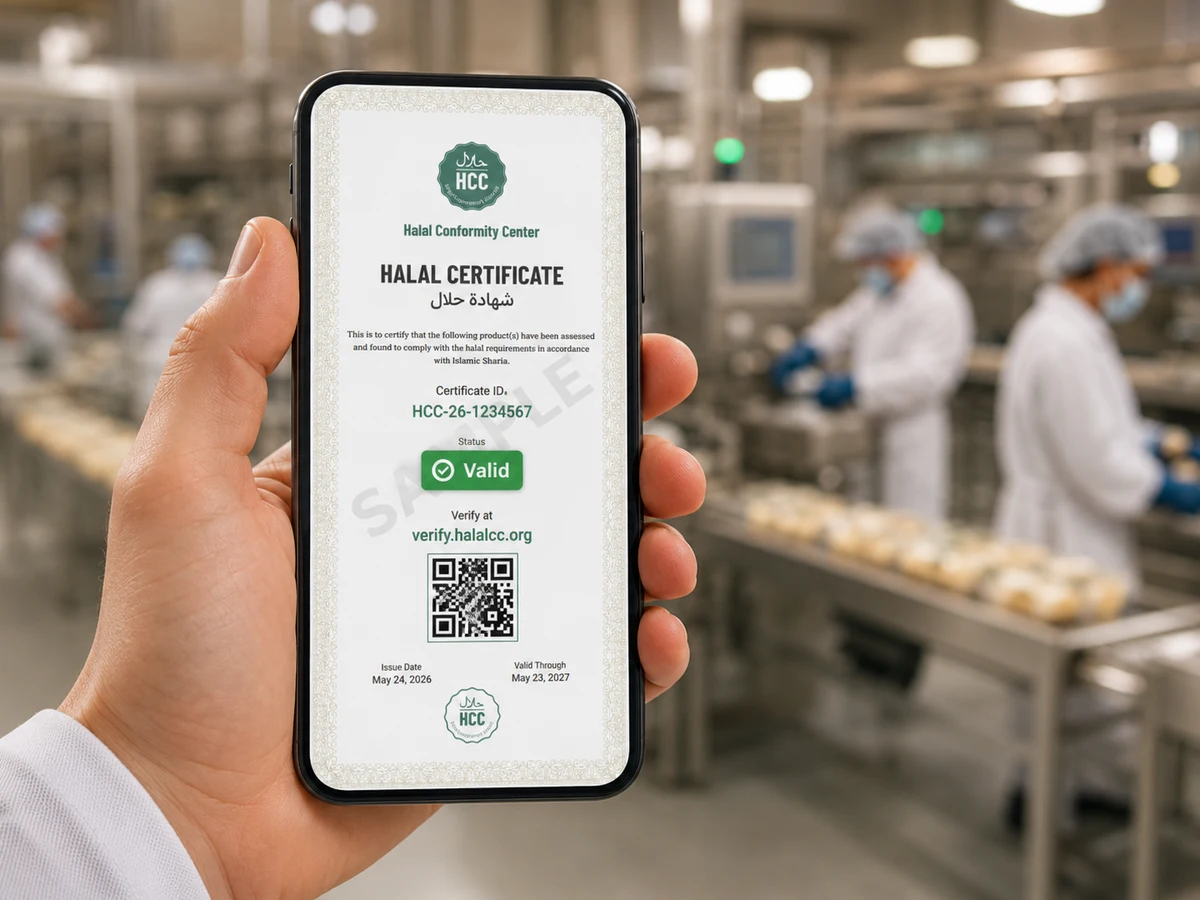
A Halal logo is only as good as the record behind it. Real-time verification is what turns a claim into trust — and protects honest makers from fake marks.
Ready to get certified?
Average issuance is about ten days from a clean application. Submit a batch for audit, or talk to a certification advisor about your scheme, market, and timeline.